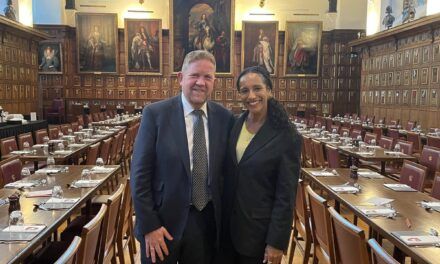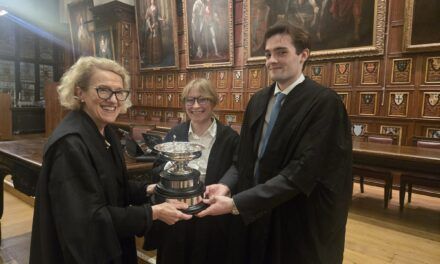
Professor Matthew Weait, Autumn Reader 2025
Below is a transcript of Master Matthew Weait’s Reading, which he delivered at Reader’s Feast on Wednesday 12 November 2025.
Summary
In 1661, John Evelyn, a member of this Inn, published ‘Fumifugium’ – arguably the first English critique of urban air pollution, linking smoke, sickness, and civic responsibility. Today, that same connection between environmental degradation and human health underpins the Rights of Nature movement, which seeks to recognise ecosystems as rights-bearers rather than objects of exploitation. This lecture explores whether such legal recognition could become an effective tool for minimising the risk of zoonotic disease. It will suggest, building on my academic research into law and HIV, that while rights frameworks have transformative potential, they will only ever be aspirational without effective enforcement. Framed through the lens of One Health, an interdisciplinary movement that recognises the interdependence of human, animal, and ecosystem health, and consideration of international constitutional, legislative and judicial case law developments, I assess the promise and limits of this radical legal innovation for tackling the ecological determinants of pandemic risk.

Reading
In his diary entry for 29 May 1660 John Evelyn, staunch royalist and member of Middle Temple, describes the procession through the City of London marking the restoration of Charles II. Evelyn witnessed the event from the Strand, describing:
A triumph of above 20,000 horse and foote, brandishing their swords and shouting with inexpressible joy; the wayes strewed with flowers, the bells ringing, the streets hung with tapissry, fountains running with wine; the Maior, Aldermen, all the companies in their liveries, chaines of gold, banners; Lords and Nobles clad in cloth of silver, gold, and velvet; the windowes and balconies all set with ladies; trumpets, music, and myriads of people flocking, even so far as from Rochester, so as they were seven hours in passing the Citty, even from two in the afternoone till nine at night.
London must have been a marvellous sight on that late spring day, and no doubt the celebrations and drinking would have diverted the crowd’s attention from the fact that it was a city that stank to high heaven, with air quality so appalling that elsewhere Evelyn wrote that it more ‘resembles the face rather of Mount Ætna, the Court of Vulcan, Stromboli, or the Suburbs of Hell, than an Assembly of ration creatures and the imperial seat of our incomparable monarch’.
Evelyn’s concern with the effects of the rancid smoke that emanated from the sea-coal fuelled premises of the brewing, lime-burning, soap-boiling and other industries in the capital were in part political (he felt strongly that the honour of the city, the nation and the monarchy were, quite literally, being besmirched); but he was also concerned with the impact of pollution on the people. Drawing on both philosophy and science – he was a founding member of the Royal Society – Evelyn published one of the earliest treatises on the impact of industry on the environment, and what we would today call zoning. ‘Fumifugium: or The Inconvenience of the Aer and Smoak of London Dissipated’, written for the King and published at His command, is a unique and prescient work setting out Evelyn’s vision for a London in which breweries and factories would be moved from the centre of the city and replaced by extensive fields of flowers, herbs and crops. Although the King seems to have been sympathetic, this was soon after the restoration. Not only did he have other more pressing matters to attend to, but London’s economy was heavily reliant on the businesses fuelled by sea-coal, there was precious little scientific evidence to support Evelyn’s project, and no institutional regulatory mechanisms that would have been needed for enforcement.
Evelyn’s appeal to the King was a plea for urban improvement and beautification, but it also recognised that the quality of our environment is inseparable from our health and wellbeing. Less than five years later, on September 7 1665, at the height of the plague and just a few months after the extract in the booklet you have with you this evening, he wrote in his diary:
Came home, there perishing now neere ten-thousand poore Creatures weekely: however I went all along the Citty & suburbs from Kent streete to St James’s, a dismal passage & dangerous, to see so many Cofines expos’d in the streetes & the streete thin of people, the shops shut up, & all in mournefull silence, as not knowing whose turne might be next […]
‘The streete thin of people, the shops shut up, & all in mournefull silence’. Those of us who were in London during the Covid-19 lockdowns three and a half centuries later will find this account uncannily familiar. The bubonic plague of Evelyn’s city, originating in rats and fleas had in 2020 become a pandemic with its origin in bats via infected intermediate hosts. Both are examples of what is called zoonotic spillover: when a pathogen originating in a non-human reservoir crosses the boundary into the human world.
It is estimated that around two thirds and three quarters of emerging infectious diseases affecting humans originate in non-human animals: HIV and mpox from primates, influenza from birds and swine, Covid-19, Ebola and Marburg from bats. And most such diseases trace back to a point at which human activity, whether that be the consumption of bushmeat, tourism, farming and agriculture, trade, deforestation, or anthropogenic climate change has disrupted or broken down the ecological partitions that normally maintain viral reservoirs in their original, and typically unaffected, host species. Rodents, for example, thrive in habitats where their natural predators have been removed and food sources multiplied by agriculture or urban waste. Bats, many of which are acutely sensitive to the environmental conditions in which they roost, may migrate to more densely populated areas, or to barns housing domesticated animals, when those conditions change. If and when such disturbance happens, they are more prone to shed virus, creating intermediate hosts if those animals are consumed.
Covid-19, caused by Severe Acute Respiratory Syndrome Coronavirus Two (or SARS-CoV-2), was the most recent demonstration of this. Genomic analyses have consistently identified horseshoe bats as natural reservoirs for SARS-related coronaviruses, providing the closest known viral relatives to SARS-CoV-2 and affirmed their central role in the emergence of these pathogens. Further epidemiological, genomic and environmental analysis strongly confirms the Huanan Wholesale Market, a wildlife market, as the site of the initial spillover from animals to humans. And take another couple of examples. HIV spillover was primarily caused by direct contact between humans and African primates, especially through bushmeat consumption and butchering practices. There is also a hypothesis that medical research involving primates may have contributed. These factors created opportunities for simian immunodeficiency viruses to cross into humans and eventually adapt, leading to the HIV pandemic. As for mpox, outbreaks such as the one which occurred in 2022 are primarily driven by increased human-wildlife contact. Environmental changes, deforestation, and urban expansion increased the risk of spillover, and factors such as travel and tourism, trade, and healthcare disparities, along with viral adaptation, increased the risk of human-to-human transmission and contributed to its realisation.
The toll on human lives from these zoonotic diseases is staggering. Best estimates are that in excess of 44 million people have died from AIDS-related illnesses since the beginning of that epidemic, and more than 7 million from Covid-19. And of course, these and other spillover diseases have imposed massive and ongoing economic costs. The World Bank and World Health Organization (WHO) have estimated that between 2020 and 2024, Covid-19 resulted in a cumulative economic output loss of an almost inconceivable $13.8 trillion, the result of output collapse and its impact on trade, travel, education, labour markets, and human capital. These diseases not only cause human suffering and threaten public health: they undermine economic growth, food security, and poverty alleviation, especially in low-income regions. Their impact underscores the need for proactive, integrated global strategies to prevent and control zoonotic spillover events.
It is law’s existing and potential contribution to those strategies that I want to explore in the remainder of this lecture.
From what I have said already, it should be obvious that the law plays an important role in the causes, trajectory and consequences of zoonotic spillover: property rights allocate and determine the use of land; environmental regulations (or their absence) determine the extent and kind of use; agricultural and trade laws shape how and which animal species are bred, sold, and transported; food standard and safety laws regulate production and sale; scientific and medical research standards impose legal duties on those working in laboratories.
The problem, and the challenge, is that these laws and regulations are fundamentally anthropocentric. They have been and continue to be devised and implemented to protect human interests, and largely, if not exclusively, the specific interests of humans who have historically benefited from industrialisation, the exploitation of the natural resources of colonised territories, and the logic of late capitalism and its variants. It is only to be expected, of course, that such humans, and their governing representatives, should have prioritised human interests, or rather their particular interests, whether that be physical security and wellbeing or competitive economic advantage; but, as climate change, biodiversity loss and pandemic disease are demonstrating with terrible, and ever starker clarity, this comes at huge cost.
Take a concrete illustration. In the autumn of 1998, there was an outbreak of Nipah virus infection in humans in Perak state, Malaysia. The host of Nipah virus is the fruit bat, whose natural habitat is lowland forest. During the 1990s, the deforestation rate in Malaysia was around 80,000 hectares of forest annually, much of this land being converted to palm oil plantations, orchards and pig farms (to give an idea of size, Greater London is just over 157,000 hectares, so it’s the equivalent of our city being deforested every two years for a decade). The impact of this on the bats was that they came into closer contact with high-density livestock farming and agriculture; and where the orchards and pig farms were in proximity, they came to eat the fruit and shed virus into pig food. The pigs became infected, and the virus spread between them and from them into farm workers, where it caused life-threatening encephalitis. By the spring of 1999 the infection had spread, resulting in 265 cases and more than a hundred deaths. One million pigs were slaughtered, and the net loss to the Malaysian economy was estimated at over $600 million.
The Nipah outbreak did not cause a global pandemic in the same way that HIV or SARS-CoV-2 did, although Nipah still has the potential to do so – with potentially even direr consequences; but it is an object lesson in the way anthropocentric legal systems may be insufficient to protect us, and the planet, from zoonotic disease. The reasons for this, and I think what follows is of more general application, are as follows.
First, while states through their public health laboratories might not be to blame for not immediately identifying a novel virus, or initially misidentifying it as an existing pathogen (which is what happened in the case of Nipah), they are responsible for the conditions that enable viruses to spread from their original host, facilitate movement within vector species (in this case pigs), and via those species to the human population. Destroying the natural habitats of animals known to be viral hosts, failing to establish buffer zones between livestock bred for consumption and the food sources of those hosts, permitting the high-density farming which facilitates transmission and the build-up of viral reservoirs, and neglecting to implement adequate biosecurity measures – these are all risk factors that can be addressed through laws and regulations, but are ones that may be treated, and in some cases have been treated, as less important than the extraction of maximum yield. Put another way, legal and regulatory frameworks may fail wholly or adequately to internalise external costs.
Second, where preventive or precautionary measures have been lacking or inadequate, it is critical that identifying potential epidemic or pandemic risk and responding appropriately when such risk materialises is vital. At the national level, this involves veterinary, environmental, and public health agencies monitoring animal reservoirs, agricultural practices, and human disease incidence. Globally, it is coordinated through mechanisms such as the World Health Organization’s Global Early Warning and Response System, jointly operated with the Food and Agriculture Organization (FAO) and the World Organisation for Animal Health (WOAH), and the International Health Regulations (2005), which require states to notify WHO of potential ‘public health emergencies of international concern’, or PHEICs. These frameworks depend on the timeliness, transparency, and coordination of national surveillance systems, conditions often undermined by political, technical, and financial constraints. In the case of Nipah, the fact that it was initially misidentified as a different pathogen spread by mosquitoes meant that precious time was lost through ineffective containment measures. It was when field epidemiologists in the outbreak region realised that ethnic Chinese workers were falling ill but not Muslims, who do not work with pigs, that it became clear the disease was being transmitted through pigs as intermediary hosts. And during Covid-19, surveillance capacities varied markedly. Rapid genomic sequencing and data sharing enabled early identification of SARS-CoV-2 variants, but delayed notification and fragmented early reporting contributed to the virus’s global spread. The declaration of a PHEIC in January 2020 was intended to trigger global mobilisation under the International Health Regulations, but many states failed to act decisively until community transmission was well established. As the Independent Panel on Pandemic Preparedness and Response, or IPPPR, concluded:
Preparation was inconsistent and underfunded. The alert system was too slow—and too meek. The World Health Organization was underpowered. The response has exacerbated inequalities. Global political leadership was absent.
Subsequent declared public health emergencies, such as that for mpox in 2022, have faced similar criticisms: that the system is reactive rather than preventive, politically constrained, and overly dependent on the discretion of the WHO Director General. Many have argued that the International Health Regulations framework incentivises countries to under-report outbreaks, fearing economic repercussions, and that it inadequately integrates surveillance data from animal and environmental sources.
The problem, put simply, is that the current surveillance and response framework is fragmented, underfunded, and vulnerable to political considerations trumping scientific evidence. The International Health Regulations impose reporting duties on states once disease emerges but have nothing to say about the ecological factors that increase the risk of emergence. The Convention on Biodiversity contains articles on ecosystem health but lacks enforcement mechanisms that could compel effective preventive action. The result is a gap where prevention should arguably be strongest.
The question, then, is what might fill that gap; and this is where One Health and, potentially, what are known as Rights of Nature, come in.
The term One Health originates in the idea of One Medicine, formulated and advocated by the American veterinarian Calvin Schwabe in the 1960s. Schwabe’s insight – that the siloing of human and veterinary science was an obstacle to fighting disease, combating food insecurity and protecting the environment – has been gaining momentum since the beginning of this century.
Described by the WHO as a ‘unifying approach that aims to sustainably balance and optimise the health of people, animals and ecosystems’, One Health promotes interdisciplinary collaboration to address health challenges including food safety, water quality, and anti-microbial resistance, as well as zoonotic disease.
It is a term used explicitly in the Manhattan Principles, drafted in 2004 by a panel of experts on the initiative of the US Wildlife Conservation Society. These principles call on states and scientists to adopt a holistic approach to the problem of complex, transboundary risks. Since then, One Health has moved from novel concept to widely accepted element of global health security strategy. At the instigation of a number of interested international organisations, a One Health High-Level Expert Panel (OHHLEP) was established in 2021, in the aftermath of Covid-19, with a mandate to advise on identifying, and so helping to prevent, future pandemics.
One Health has a number of elements, of which three are of particular relevance here. The first is coordinated early detection and surveillance, involving the sharing of data between doctors, veterinarians, and wildlife experts to monitor pathogens in animal populations (such as influenza viruses in birds or coronaviruses in bats) before they spill over into the human population. The second is the coordination of response. One Health creates channels for different sectors and disciplines to respond jointly when a threat emerges. The idea is that should there be a zoonotic outbreak, public health authorities, agricultural and animal health services, and environmental agencies can pull together a unified strategy. This could, for example, entail managing infections in livestock or wildlife while treating and isolating human cases. The third element, arguably the most innovative, is addressing the fundamental, or original, source of spillover risk – factors that I have already mentioned such as deforestation, wildlife trade, intensive farming and climate change. One Health promotes prevention by focusing attention on the importance of attending to the relationship between biosecurity, the regulation of wildlife markets and trade, and habitat conservation.
Most recently, and potentially most significantly, One Health has been included in the WHO’s Pandemic Agreement. This is a multilateral treaty negotiated under the authority of the World Health Assembly and intended to establish international obligations and cooperative mechanisms for pandemic prevention, preparedness, and response. Prompted by the impact of Covid-19 and the systemic shortfalls in response that this exposed, the agreement was adopted in May this year and is the first time that what will, when ratified, become a binding legal text has affirmed the importance of a unified, holistic, approach based on One Health principles.
The gradual integration of these principles in national, regional and international law is a positive development but it is not without its challenges: the institutions responsible for its implementation remain fragmented and underfunded; its ambitious, holistic, formulation makes it difficult to translate into specific, measurable, standards or enforceable, prescriptive language (indeed, the Pandemic Agreement itself affirms the importance of the approach, but does not impose justiciable obligations); and, critically, it manifests a fundamentally anthropocentric bias. Although the goal is to integrate human, animal, and ecosystem health, One Health focuses on how that integration can serve human interests rather than the interests of non-human animals and ecosystems. It may be thought that this is a perfectly reasonable emphasis, and that as long as it gets the job done, a more fundamental realignment of the interests at stake is unnecessary. The problem with this is that a human-focused and instrumentalist approach may only address the symptoms rather than the root causes of zoonotic spillover. If there is to be what has been called ‘upstream’ or ‘deep’ prevention, there are strong arguments from moving from an anthropocentric to an ecocentric approach, and this is where, what is termed, Rights of Nature comes in.
Rights of Nature, not to be confused with natural rights, is a legal and philosophical concept which holds that ecosystems and natural entities (such as rivers, coastlines, estuaries and forests) possess immanent or inherent rights to exist, thrive, and evolve in a way comparable to the way in which we understand human rights. Law (or rather law in the Anglo-American common law and continental civilian tradition) has treated nature and natural phenomena as property without standing; as a resource which, to a greater or lesser extent, is open to extractive exploitation for the benefit of human beings. In contrast, Rights of Nature is grounded in an ecocentric, or biocentric, logic in which it is both plausible and desirable that natural phenomena should be accorded legal personhood and have standing to assert their interests (in freedom from damage or destruction, in thriving and renewal), through representatives or guardians, on their own account, in their own name.
A few examples will give a flavour of what this means in practice, as well as a sense of why and how rights of nature typically find the most vivid expression in countries and regions where indigenous peoples and their beliefs have been excluded and repressed.
Perhaps the most celebrated constitutional recognition of Rights of Nature is found in Articles 71 to 74 of Ecuador’s Constitution of 2008. Grounded in the indigenous Andean concepts of buen vivir and Pacha Mama (living well, or in harmony, and Mother Earth), Article 71 states ‘nature, or Pacha Mama, where life is reproduced and occurs, has the right to integral respect for its existence and for the maintenance and regeneration of its life cycles, structure, functions and evolutionary processes’ and that ‘all persons, communities, peoples and nations can call upon public authorities to enforce the rights of nature’. The Constitution also empowers courts to compel restoration and award compensation where damage has occurred.
It was these provisions that were critical in the 2021 decision of the Ecuador’s Constitutional Court in the Los Cedros case. This case concerned Los Cedros, a biodiverse and ecologically fragile cloud forest reserve. In 2017 the Ministry of the Environment and the state mining company had granted exploratory permits to a Canadian-backed mining firm within the forest. In its judgment, the court ruled that the authorisation of mining exploration breached the constitutional rights of the forest itself. Citing Article 71, the court held that the state had failed to apply the precautionary principle as required by Article 73 and that the potential harm extended beyond human interests to the integrity of the ecosystem and the survival of endemic and endangered species. It annulled the mining permits, ordered restoration measures, and reaffirmed that all levels of government must ensure that activities within protected forests are compatible with nature’s constitutional rights. In doing so, the court’s reasoning moved beyond traditional environmental law, which regulates human use of resources, and instead asked whether the forest’s own right ‘to exist and to regenerate’ had been infringed. By doing so, it confirmed that rights of nature provisions need not be merely symbolic or aspirational but can create enforceable obligations.
Across the Pacific, New Zealand arguably offers the most significant non-constitutional legislative example in the Te Awa Tupua (Whanganui River Claims Settlement) Act 2017. From a Rights of Nature perspective, the Act recognises the river itself, Te Awa Tupua, as ‘an indivisible and living whole, comprising the Whanganui River from the mountains to the sea… incorporating all its physical and metaphysical elements’. Furthermore, it states that ‘Te Awa Tupua is a legal person and has all the rights, powers, duties, and liabilities of a legal person’ with those rights exercised by guardians who must ‘act and speak for and on behalf of Te Awa Tupua’. Although there have been no appellate decisions relating to this legislation, it has informed planning projects impacting the river. For example, resource consents in the Whanganui Port Revitalisation Project were reviewed through Te Awa Tupua principles, with each consent decision recording how the river’s intrinsic values as well as its health and wellbeing had been taken into account.
Closer to home, and almost exactly a year ago, Spain’s Constitutional Court upheld the constitutionality of law 19/2022. This law, the result of campaigning by environmentalists and others, granted legal personhood to the Mar Menor lagoon and its basin. Mar Menor is Europe’s largest saltwater lagoon and had suffered significant degradation and pollution. It also has significant cultural significance for the people of Murcia, where the lagoon is situated. The preamble to the law states that ‘for all these reasons, the time has come to take a qualitative leap and adopt a new legal and political model, in line with international legal advancements and the global movement for the recognition of the Rights of Nature’. Quoting from an earlier Supreme Court decision on the interpretation of Article 45 of the Spanish Constitution, the preamble affirms that the ‘differentiation between harms that affect human health and risks that damage other animal or plant species and the environment is largely due to the fact that man does not feel part of nature but rather an external force destined to dominate or conquer it to put it at his service’, continuing, ‘it is worth remembering that nature does not allow unlimited use and that it constitutes a natural capital that must be protected’.
Even closer to home, in Hampshire, three local authorities have passed motions recognising the rights of that county’s chalk streams (including the Itchen, Test and Meon). Inspired by the Universal Declaration of the Rights of Rivers, an initiative of the US-based Earth Law Centre, there is an ongoing ambition to finalise, by 2026, a Declaration affirming the right of these rivers to, among other things, native biodiversity, restoration of ecological integrity, and to regeneration and restoration from environmental harm. The chalk streams are acknowledged to be globally rare ecosystems of ecological and cultural importance, and the declaration would seek to align public bodies, water companies, landowners and communities around a shared stewardship model. It would not have legal status but, along with other such initiatives in Sussex and Somerset, the declaration and the community activism and motions behind it represent what we might think of as an emerging ethic recognising rights of nature, one that might take effect through voluntary governance and local political accountability.
I hope it’s relatively clear from these examples how those who advocate for rights of nature see it as something that could strengthen One Health.
By protecting ecosystems for their own sake, giving them legal personhood, rights of nature frameworks have the potential to impede the drivers of zoonotic spillover: deforestation, habitat fragmentation, and biodiversity loss. Unlike legal regimes that regulate exploitation and resource extraction, rights of nature jurisprudence seeks to maintain the very integrity of ecosystems. One Health links human, animal, and environmental health. Rights of nature goes further by granting the environment itself enforceable standing and frames human health and wellbeing as one dimension of a more holistic ecological justice.
Of course, delivering this is far from straightforward, and there are countless examples of failing or problematic initiatives. Bolivia passed a Law of the Rights of Mother Earth in 2010, but successive governments have continued to prioritise extractive industry interests over environmental protection and leading many commentators to conclude that its commitment is honoured more in the rhetoric than in practice. In Bangladesh, a 2019 Supreme Court decision declared the legal personhood of all national rivers in order to combat decades of catastrophic pollution, but there is evidence of the forced eviction of poorer fishing-dependent communities living alongside those rivers, without consultation, resettlement or compensation. In the US, the Lake Erie Bill of Rights, an ordinance passed by the city of Toledo, was struck down in 2020 for being constitutionally vague, and on pre-emptive grounds (i.e. that it concerned a matter that was properly reserved to a higher legislative authority). Asserting Rights of Nature generates, perhaps inevitably, conflict between economic and environmental interests, local and national governance, and between the rights of ecosystems and human rights.
Despite these very real difficulties, I do believe that Rights of Nature has a role to play in One Health and in pandemic prevention, primarily in reorienting the way we think about our place in the biosphere, and the potential for law to contribute to this.
One Health, in its current form, affirms the importance of institutional collaboration and health optimisation, but it operates within the traditional anthropocentric paradigm where only humans are rights-bearers. Initiatives, including the WHO Pandemic Agreement, are currently resistant to the idea that an ecosystem may, indeed should, have a right to exist and thrive, irrespective of the benefit of this to human populations. And for as long as this is the case, the root causes of zoonotic spillover will not be adequately addressed. The challenge is not simply to grant ‘rights’ to nature, but to embed in law a conception of responsibility proportionate to the scale and impact of human agency in the Anthropocene. Rights of Nature frameworks help articulate the intrinsic value and integrity of ecosystems, and to provide procedural standing to non-human entities whose degradation, decimation and destruction endangers human life. But unless these frameworks integrate enforceable duties, on states, corporations, and individuals they risk remaining declaratory rather than transformative. The logic of pandemic prevention, as I hope I have shown, invites a deeper shift: conceiving nature as a bearer of rights and human beings as the bearer of obligations towards nature within a shared, precious, and fragile ecological community.
There are, inevitably, those who question the very notion of Rights of Nature; who say that granting rivers legal personhood or recognising the standing of bats, forests, and coastlines is dangerous, nonsensical, even incoherent. So be it. I would invite those people to think back to the London of 250 years ago. Not far from where we are assembled this evening, in the summer of 1772, a ship called the Anne and Mary was moored on the Thames, most likely between the Pool of London and Deptford. Its master, Captain Knowles, had surrendered from the ship to the Court of King’s Bench, on a writ of habeas corpus, one James Somerset, a slave belonging to Charles Stewart. The question before the court, presided over by the Lord Chief Justice, Lord Mansfield, was whether James, being a slave, could be forcibly removed from England at the will of his owner. Mansfield held that he could not, declaring:
The state of slavery is of such a nature, that it is incapable of being introduced on any reasons, moral or political, but only by positive law, which preserves its force long after the reasons, occasion, and time itself from whence it was created, is erased from memory. It is so odious, that nothing can be suffered to support it, but positive law.
The case of Somerset v Stewart did not abolish slavery, but it marked a turning point in its moral and legal unravelling. Two Middle Templars, Richard Brinsley Sheridan and Edmund Burke, were among the most eloquent advocates of abolition. In the parliamentary debates that led to the 1807 Slave Trade Abolition Act, Sheridan – playwright and parliamentarian – declared that he ‘did not like to hear the term property applied to the subjects of a free country. Could man become the property of man?’ The point is that until slavery’s abolition, until it was recognised as fundamentally wrong, man could indeed be the property of man; and as property, the maximum value could legitimately be extracted from his body through labour, just as today it is extracted by public and private enterprise from natural resources – diluting the planet’s biodiversity and increasing the risk of zoonotic disease spillover.
If we go back another hundred years, to the late 17th Century, we encounter another form of misplaced thinking. It was widely believed that the monarch could cure scrofula, a non-pulmonary tuberculosis known as the King’s Evil. Crowds would gather in the hope that Charles II’s sacred body might heal them (though our Middle Temple forebear John Evelyn recounts in another of his diary entries an occasion not when someone was cured, but of people being trampled to death in the scrum).
The legal recognition of the rights of nature does not promise a miracle, but rather a method: not magical thinking, but a rational, grounded, and just means of restoring equilibrium between human interests and the natural world on which we depend for our health and wellbeing.
People in the 17th Century may have misguidedly, and through ignorance, looked to the King’s touch to combat disease; we in the 21st Century, with the benefit of reason and evidence, could do worse than look to the law for its defeat.

Matthew Weait is Emeritus Professor of Law and Society at the University of Oxford and Fellow of Harris Manchester College. His research focuses on law and public health, particularly HIV prevention. He has advised a range of international organisations and has a longstanding commitment to excellence in legal education and lifelong learning.