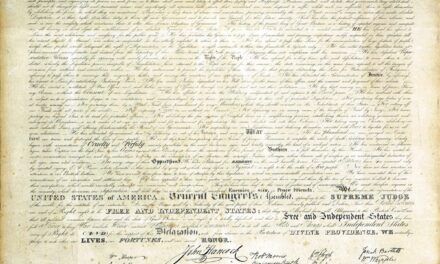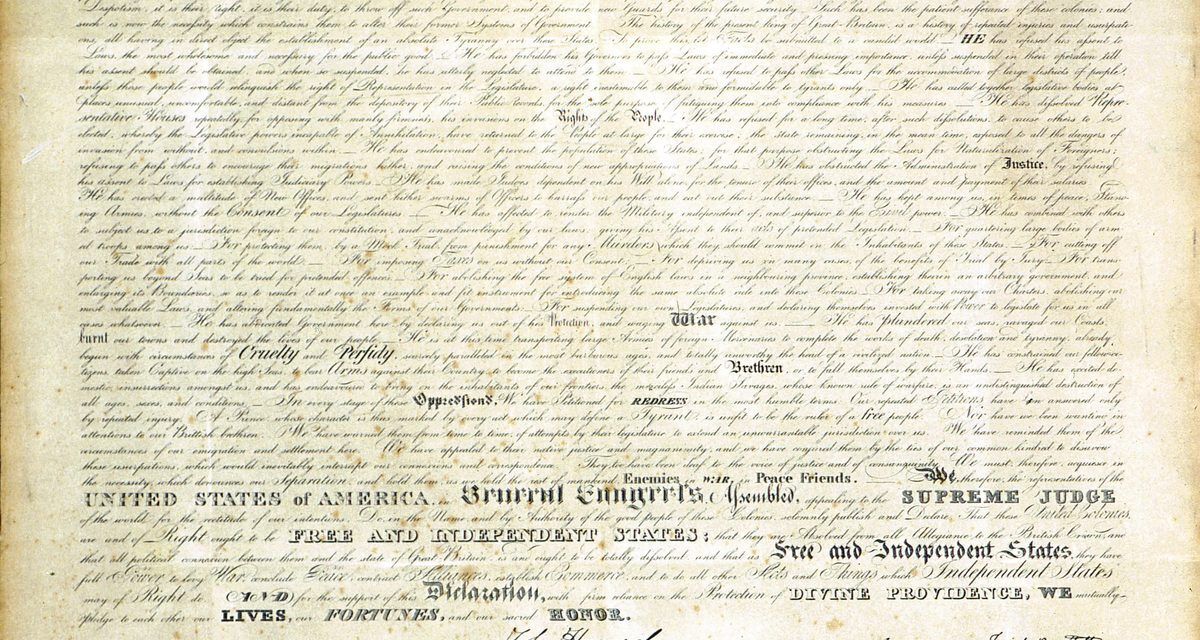
This year marks 250 years since the American Declaration of Independence, issued on Thursday 4 July 1776. Members of the Middle Temple played a significant role in this historic event and in the surrounding years, but the Inn’s American connections predate this by many centuries and endure to this day. An exhibition mounted this summer in the library sought to explore that long and often complex relationship, from the pivotal moment of Magna Carta to the intertwined histories of empire, education, revolution and the ongoing importance of the library’s US Collection.
These connections arguably date back to before the Inn existed and before America was a territory known to Europeans. The Temple Church was an important site in the events and negotiations which led to Magna Carta, in 1214-1215. Magna Carta went on to underpin the US Constitution and the Bill of Rights in its emphasis on due process and the protection of individual rights.
Exploration & Empire
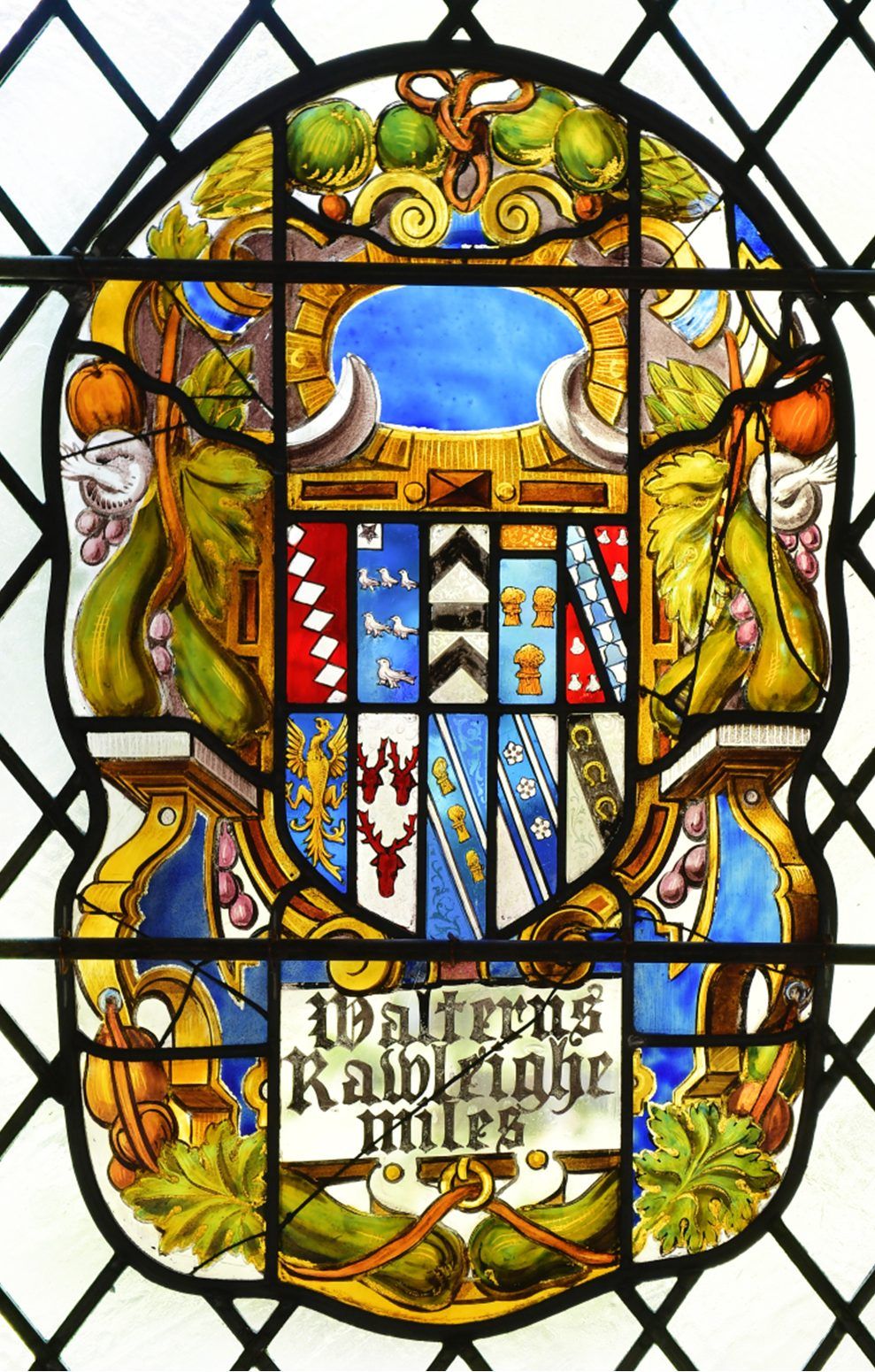
In 1585, the Middle Templar Sir Walter Raleigh founded the first English colonial settlement in America on Roanoke, an island off the coast of modern-day North Carolina already inhabited and governed by Indigenous peoples. The settlement failed, but the Inn remained a centre of interest in colonial ventures.
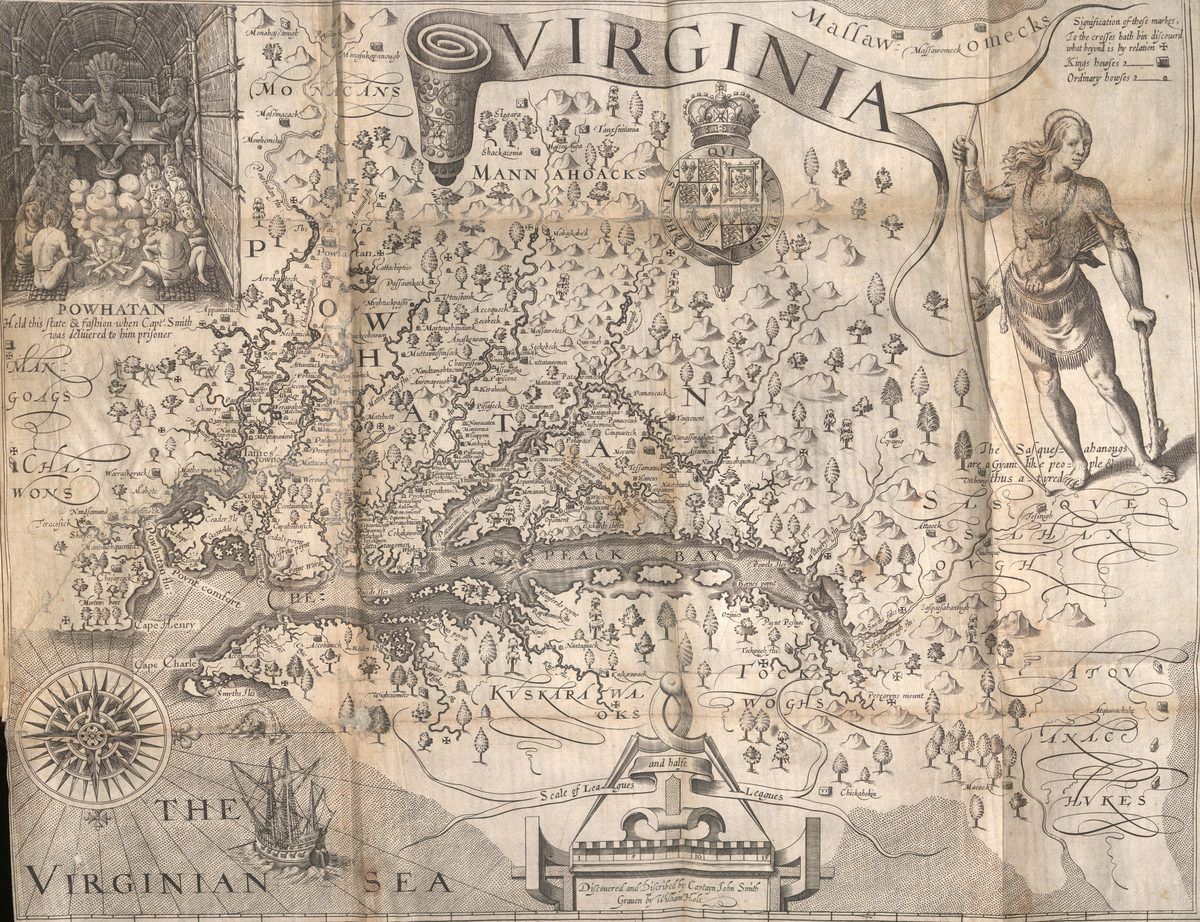
In 1606 King James VI and I chartered the Virginia Company of London to establish a new colony, and many Middle Templars were among those invested in the project, which saw the Jamestown colony set up in 1607, an event which led to displacement and violence against Indigenous peoples in the region. The colony’s struggling fortunes by 1613 led Middle Templars in London to produce the Memorable Masque, a courtly entertainment with a Virginian theme, aimed at reigniting royal support.
The colony eventually turned a corner as a consequence of the cultivation of tobacco on plantations, which relied increasingly on the labour of enslaved men and women. The company adopted a ‘Great Charter’ in 1618, drafted by the Middle Templar Edwin Sandys, but in 1624 King James took over the colony.
American Students at the Inn
The first Middle Temple student known to be from the English colonies in America was admitted to the Inn in 1692—one Benjamin Lynde of Boston. Over the decades to come, over 150 young men would cross the Atlantic for a legal education in London.
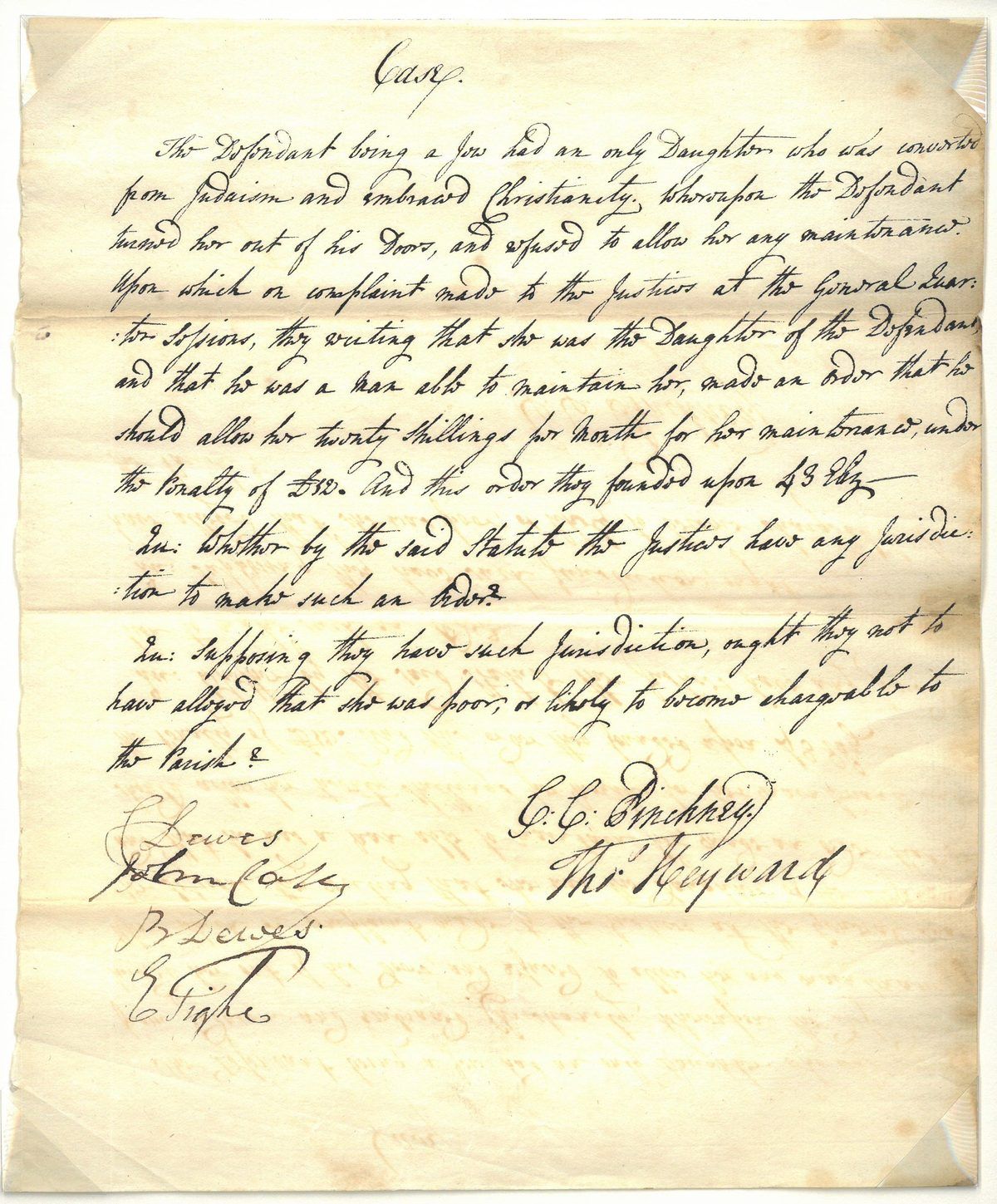
There are limited archival sources available as to the formal education available for students at the Inn in those days, but some records survive. One of these, a ‘Candlelight Exercise’, records an exercise undertaken by two American students concerning a father’s obligation of maintenance under the Elizabethan Statute of Charitable Uses to his daughter, who had converted from Judaism to Christianity. A revolutionary future lay ahead for both students. Charles Cotesworth Pinckney served as a Brigadier General in the Revolutionary War and signed the Constitution; he was a lifelong enslaver and fiercely opposed to emancipation. Thomas Heyward, also an enslaver, was one of five signatories to the Declaration of Independence who studied at the Inn.
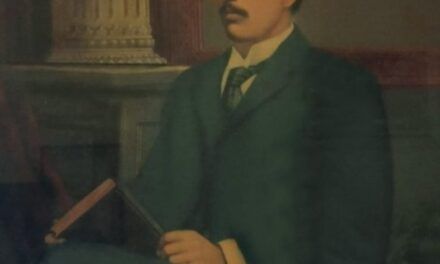
Beyond this handful of records, some of the best sources for understanding the activities, interests and diversions of American colonial student in London come from the letters they sent home, particularly those of John Dickinson, born in Maryland in 1732, who joined the Inn in 1753.
Dickinson was awed to be studying in a place frequented by some of the great legal figures of past ages, writing ‘perhaps I study in the Chambers, where a Coke or Plowden has meditated’. Much of his time was spent reading: ‘I fly to Books, to Retirement, to Labour, & every Moment is an Age, till I am immersed in Study.’
Another important dimension was time spent at the courts at Westminster Hall, described by Dickinson as ‘a school of law where we not only hear what we have read repeated, but disputed & sifted in the most learned manner… The Barr is a perfect comment upon the written law, & every great man at it is in some measure a master & instructor to students who have the wisdom to attend.’
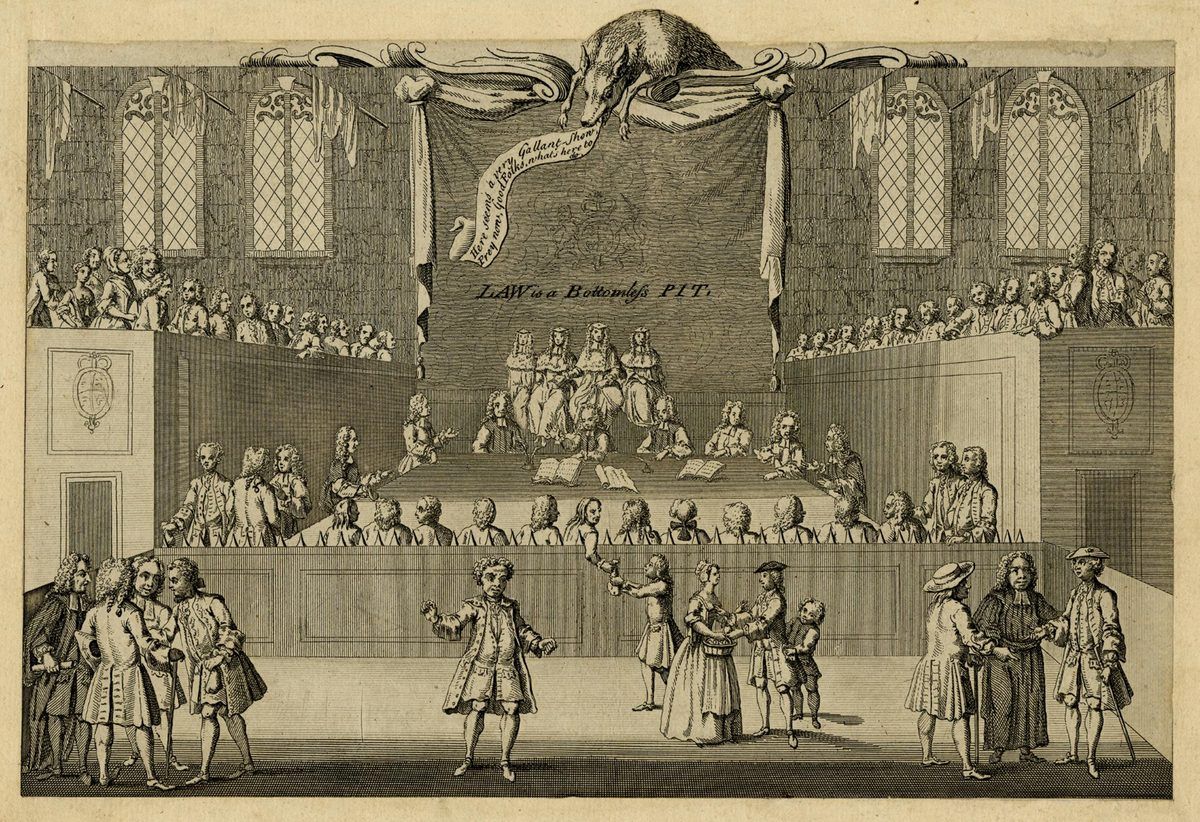
Many extracurricular activities, cultural pursuits and temptations were available in London. Dickinson was at pains to assure his parents of his own good behaviour: ‘As to the vicious pleasures of London, I know not what they are; I never hear [or] think of them.’ He did acknowledge the richness of London’s humanity, noting that ‘More is learnt of mankind here in a month than can be in a year in any other part of the world.’
Revolution
British taxation of its American colonies in the 1760s led to a war of words in which members of the Inn played a key role. John Dickinson, now returned home to practise law and beginning to earn his reputation as the ‘Penman of the Revolution’, wrote his influential Letters from a Farmer in Pennsylvania in response to the Townshend Acts of 1767. In London the Middle Templar MPs Edmund Burke and John Dunning were among those advocating for the colonists and their grievances.
Spurred by the ‘Intolerable Acts’ of 1774, the First Continental Congress convened, led by a Middle Templar, Peyton Randolph, and submitted a petition to the King (drafted by Dickinson). Its rejection led to the outbreak of war the following spring, and a Second Continental Congress convened in May 1775.
By the summer of 1776, the clamour for independence had grown. Congress passed a resolution on Tuesday 2 July 1776 and two days later the Declaration of Independence was unanimously ratified, being signed by 56 delegates, including five members of the Middle Temple. John Dickinson, feeling the time was not yet ripe, abstained from the vote.
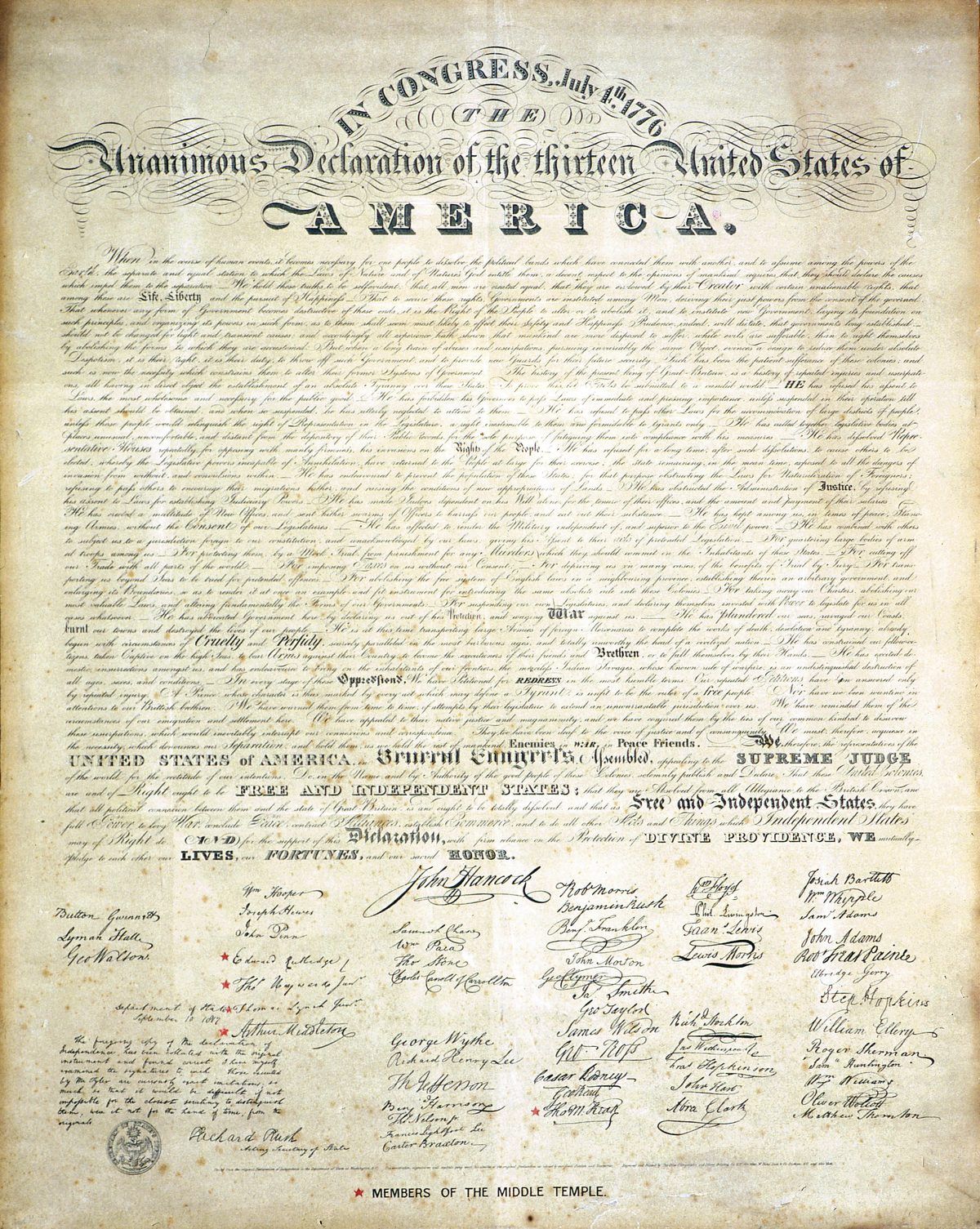
Middle Templar Signatories
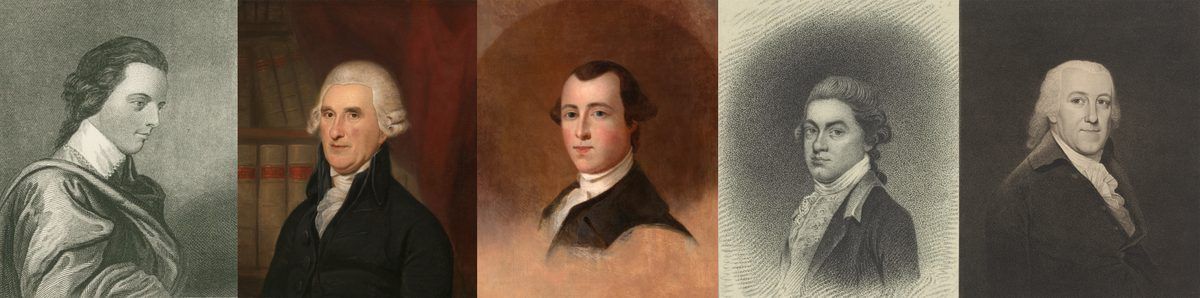
Arthur Middleton – Admitted: 1757
Middleton, a South Carolinian, was sent to England at the age of 12, studying at Cambridge and the Inn before touring Europe. Back home, he entered politics and became increasingly radical, in 1776 being elected to the Continental Congress. He was taken prisoner at Charleston in 1780, and later retired to Middleton Place, an estate and rice plantation where over a hundred enslaved people were forced into labour.
Thomas McKean – Admitted: 1758
Of Irish descent, McKean was born in Pennsylvania and after his education in London practised in Delaware, becoming an influential advocate for independence. While he was present for the crucial vote and debated the Declaration’s wording, military duty prevented his signing the document until years later. He drafted the State Constitution of Delaware and later served as Pennsylvania’s Chief Justice and Governor.
Thomas Heyward Jr. – Admitted: 1765 – Called: 1770
While in London as a student at the Inn, Heyward experienced condescension and disdain towards American colonists. His fervent anti-British sentiment led to a resolute commitment to independence. He served as a judge during the Revolutionary War and was taken prisoner at Charleston by the British, who confiscated 130 of the people he had enslaved, leading to his proclamation as a ‘martyr’ by the press.
Thomas Lynch Jr. – Admitted: 1767
Following his time in London, Lynch returned to South Carolina but gave up the law to manage his family plantation and enter politics. At the Continental Congress, he vehemently opposed movements to abolish slavery in the new United States, threatening the secession of South Carolina, a stance reflecting the determination of some elites to preserve slavery. He and his wife were lost at sea in 1779.
Edward Rutledge – Admitted: 1767 – Called: 1772
Rutledge followed his elder brothers to study at the Inn. A delegate at the Second Continental Congress, his stance on independence shifted; eventually he convinced his fellow South Carolinians to vote in favour and became the Declaration’s youngest signatory. During the war, he sought to expel Black soldiers from the revolutionary army, fearing the consequences, as an enslaver himself, of their being armed. He later served as Governor of South Carolina.
Constitution
The Revolutionary War raged on for some years, with Middle Templars involved on both sides in fighting, politics and diplomacy. Following the 1783 Peace of Paris, the independent states were somewhat dysfunctionally governed according to the 1776 Articles of Confederation, until the Constitutional Convention of 1787. Over half of the delegates were lawyers, seven of whom were members of the Inn: John Rutledge, John Dickinson, Charles Pinckney III, Charles Cotesworth Pinckney, Jared Ingersoll, John Blair and William Livingston.
Dickinson and Rutledge both played pivotal roles in resolving an early debate over voting rights between the states. Rutledge was appointed chair of the Committee of Detail, tasked with producing a first draft of the Constitution. Thanks to his energy and perseverance, the Committee completed its task after ten days of intensive work.
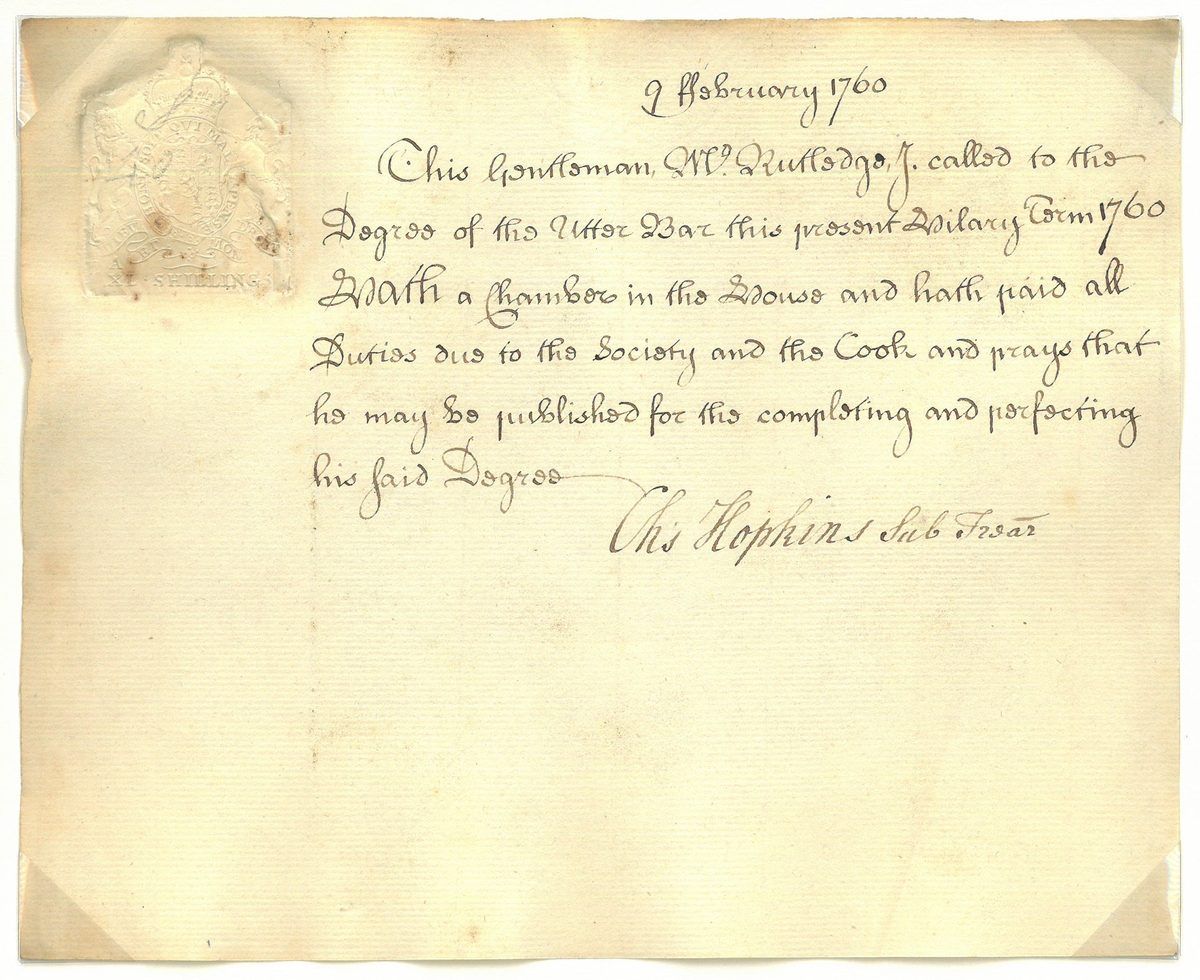
The amended draft was adopted, and 39 delegates signed the new Constitution on Monday 17 September, among them the seven Middle Templars present. The education and experience they gained while students at the Inn can clearly be discerned in this foundational legal text, along with the influence of their deep reading and immersion in the English Common Law, particularly the work of Sir William Blackstone.
Blackstone, a Middle Templar, first published his four-volume treatise in the 1760s – the first work systematically to synthesise and describe the English Common Law since the Middle Ages. It was hugely popular on both sides of the Atlantic, with Burke writing that ‘In no country perhaps in the world is the law so general a study… I hear that they have sold nearly as many of Blackstone’s Commentaries in America as in England…’
Blackstone was the second most cited authority after the Bible for the Framers of the Constitution. His writings on individual rights, philosophical architecture, and balanced approach to the abstract and the practical were all reflected in the finished Constitution and his accessible writings are still referred to today in judgments throughout the US courts.
After Independence
While admissions to the Inn from the newly independent United States declined, there were some notable exceptions, including Thomas Morris Chester, the first African American to be Called to the Bar in London.
The 20th Century saw a renewal of ties between the Middle Temple and the USA. In 1905, Joseph H Choate, US Ambassador to London, was made an Honorary Bencher, establishing a long-lived tradition. Chief Justice Taft, a former US President, was also Benched in 1922, remarking that he felt ‘strangely moved, finding myself sitting here in the home of Blackstone, in the very cradle of the Common Law of England and of America’.
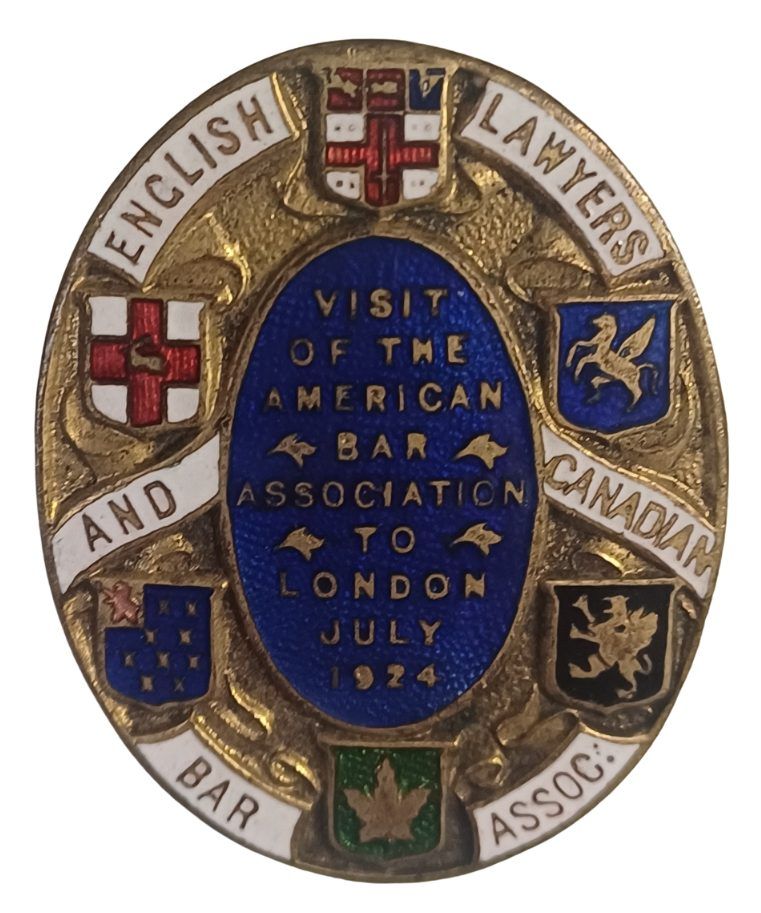
The American Bar Association (ABA) made its inaugural visit to London in 1924, a programme including a sumptuous dinner in Hall and the unveiling of a statue of William Blackstone at the Royal Courts of Justice.
The Library’s US Collection
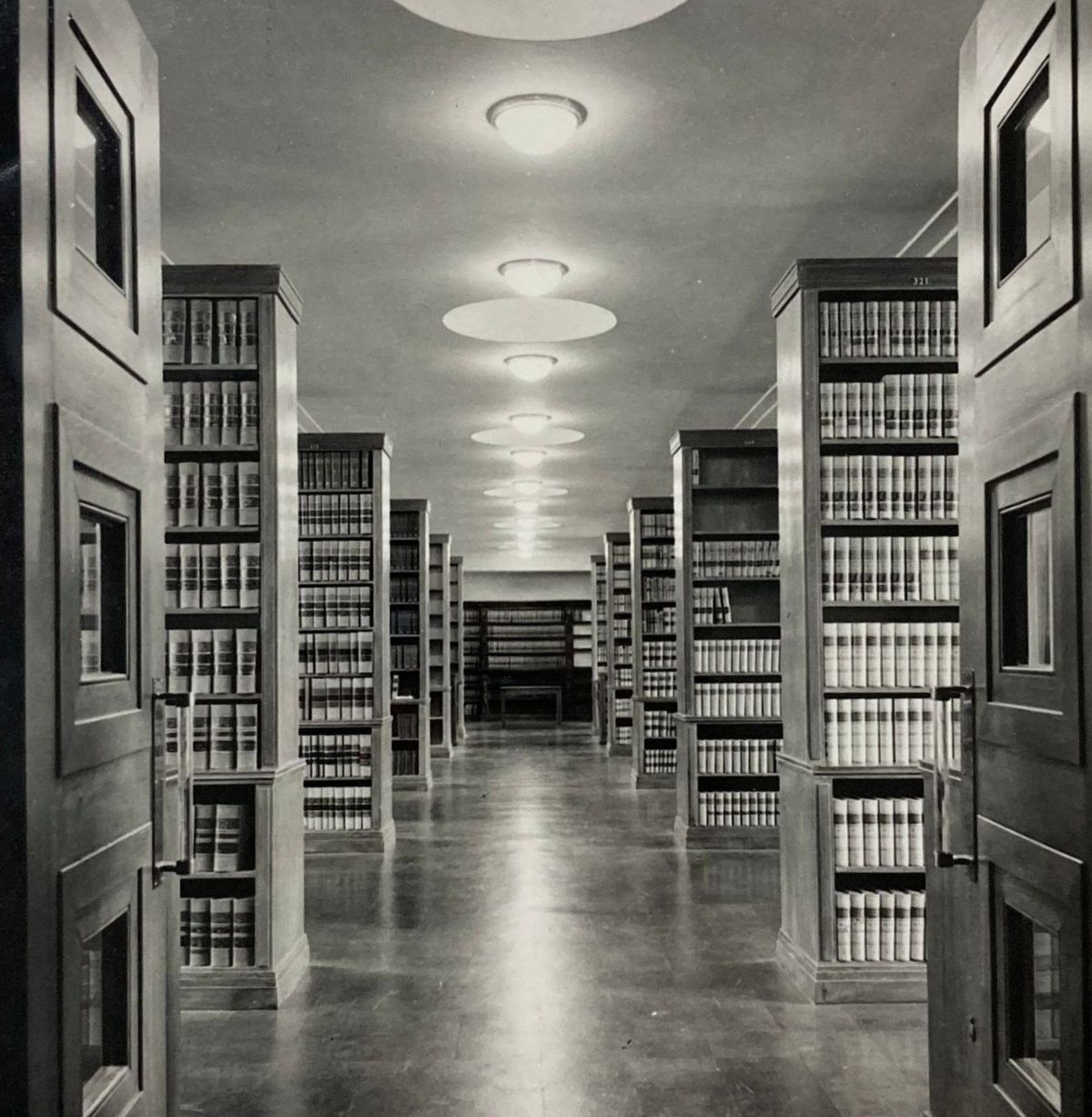
The American Library at Middle Temple was largely developed under the stewardship of Herbert AC Sturgess, who served as Keeper of the Library from 1922-1963. Shortly after taking post, Sturgess formed the ambition of acquiring a full set of American reports to meet a growing demand at the Bar for American legal decisions, which had theretofore been difficult to obtain in Britain. Sturgess’ efforts were met with enthusiasm by many American lawyers who made generous contributions to help bring the American Library to fruition.
One notable supporter of the American Library was Barnett Hollander, an American lawyer based in 3 Paper Buildings. After arriving in London to find that ‘none of the four Inns and in fact the British Museum did not have a full set of the United States Supreme Court Reports’, Hollander presented the library with a gift of the missing reports in 1926 and continued to make contributions to the collection over the next two decades. Further contributions to the collection included a gift of 147 volumes from the State of Virginia in 1927, $7000 of US law reports and books from the Carnegie Endowment for International Peace in 1929 (roughly equivalent to over $130,000 in today’s money), and 550 volumes from the US Government in 1954.
Support from across the Atlantic continued into the latter half of the 20th Century, with Honorary Bencher and US Chief Justice Warren E Burger becoming president of the Foundation for Overseas Libraries of American Law. This initiative ran from 1969 to 1982 to support the libraries at Middle Temple and the Institute of Advanced Legal Studies with the hopes that it would permit lawyers and judges to cite American precedents more freely in the courts of England and Wales. Burger also gifted the library with a volume of his Supreme Court opinions, inscribed ‘to the Middle Temple Library from Warren E Burger’ with the postscript ‘American doctors recommend five minutes reading before bedtime as a sure cure for insomnia.’
Today, the US Collection constitutes one of the library’s specialist subjects, jointly funded by the four Inns of Court and housed on the third floor of the library. The library continues to develop its physical collection of US practitioner textbooks and has expanded to provide comprehensive electronic coverage of federal and state case law, legislation and secondary resources through HeinOnline, Lexis US, LLMC Digital and Westlaw US. In 2010, the library also began formally offering US legal research training to members, which has evolved into one of the Inn’s regular Qualifying Sessions provided to student members before they are Called to the Bar.
21st Century Amity
The Inn’s long-standing links with the United States endure today in many forms. We continue to mark important historical anniversaries, and the library’s US Collection remains one of the largest collections of US law outside of America.
The Inn regularly welcomes visitors and delegations from the United States and recently hosted an ABA conference in London, marking 100 years since the 1924 visit. Middle Templars also often cross the Atlantic for Amity Visits, mooting competitions and more.
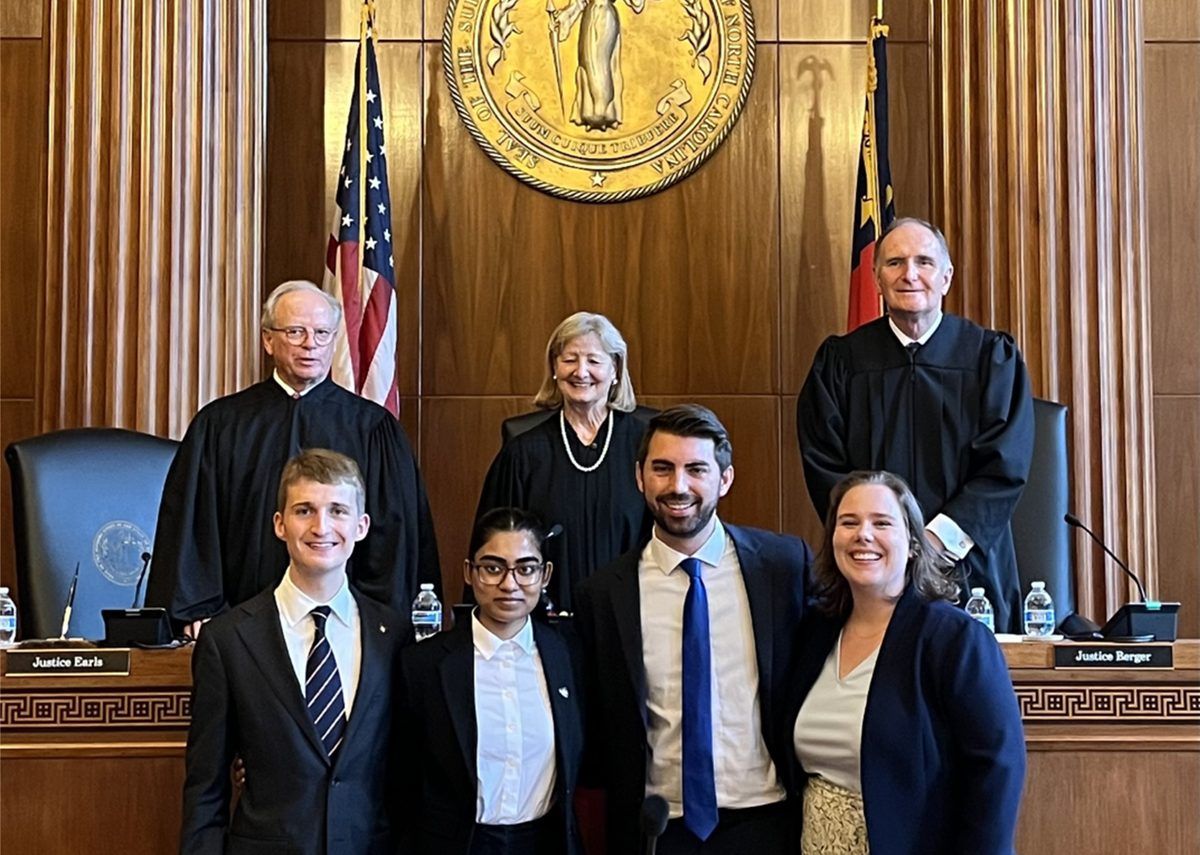
Master Mark Rylance’s comments in the programme notes for his 2006 performance at the quatercentenary of the Virginia Charter conclude: ‘Long live the friendship between America and the Middle Temple… may that friendship continue to be a force for liberty, justice and good government between all people.’ We look forward to the next 250 years.
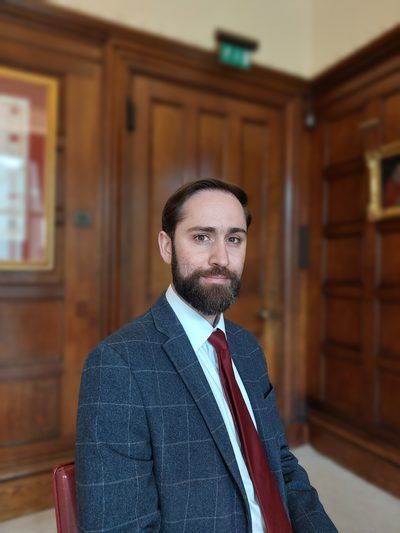
Barnaby Bryan has been with the Inn since 2015. As Archivist & Head of Collections, he is responsible for the management, care and development of the Inn’s extraordinary Archive. He oversees several of our other historic collections, including paintings, silver, armour and heraldic material. Before joining the department, he undertook archival work at various institutions, including King’s College, Cambridge, and Unilever’s corporate archive in Port Sunlight.
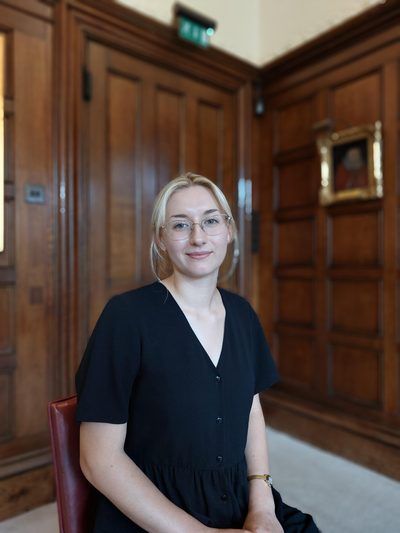
Amy Kellett is an Assistant Librarian at Middle Temple. She is responsible for the development of the US and Ecclesiastical library collections. She also contributes to the library’s regular legal research training programme to assist members in their professional development.