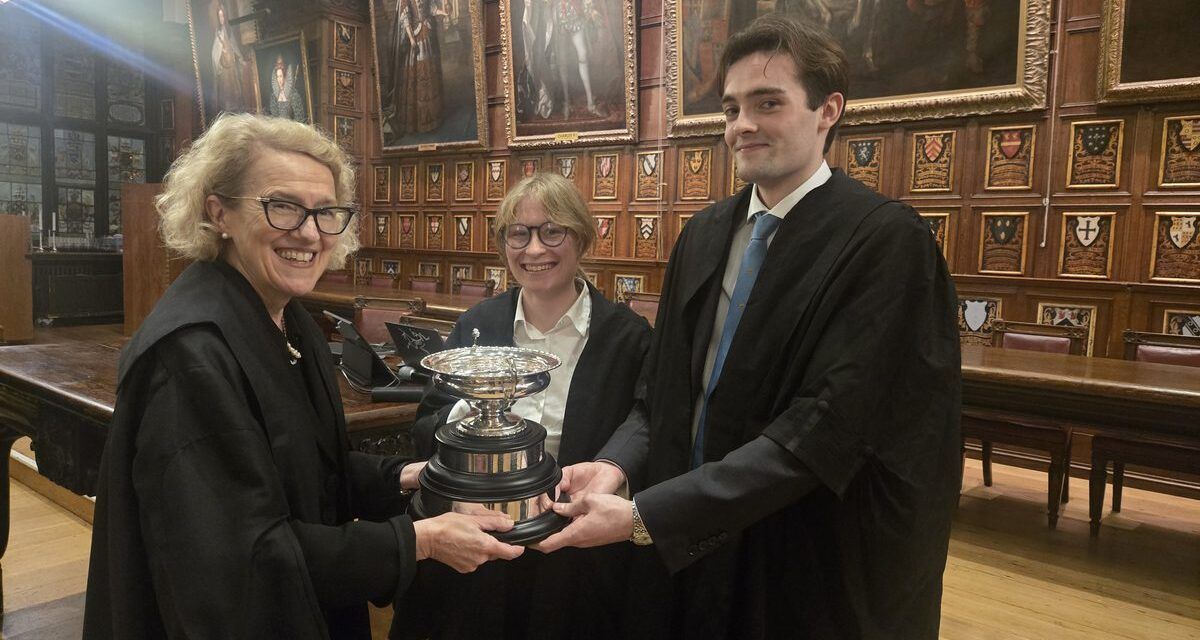
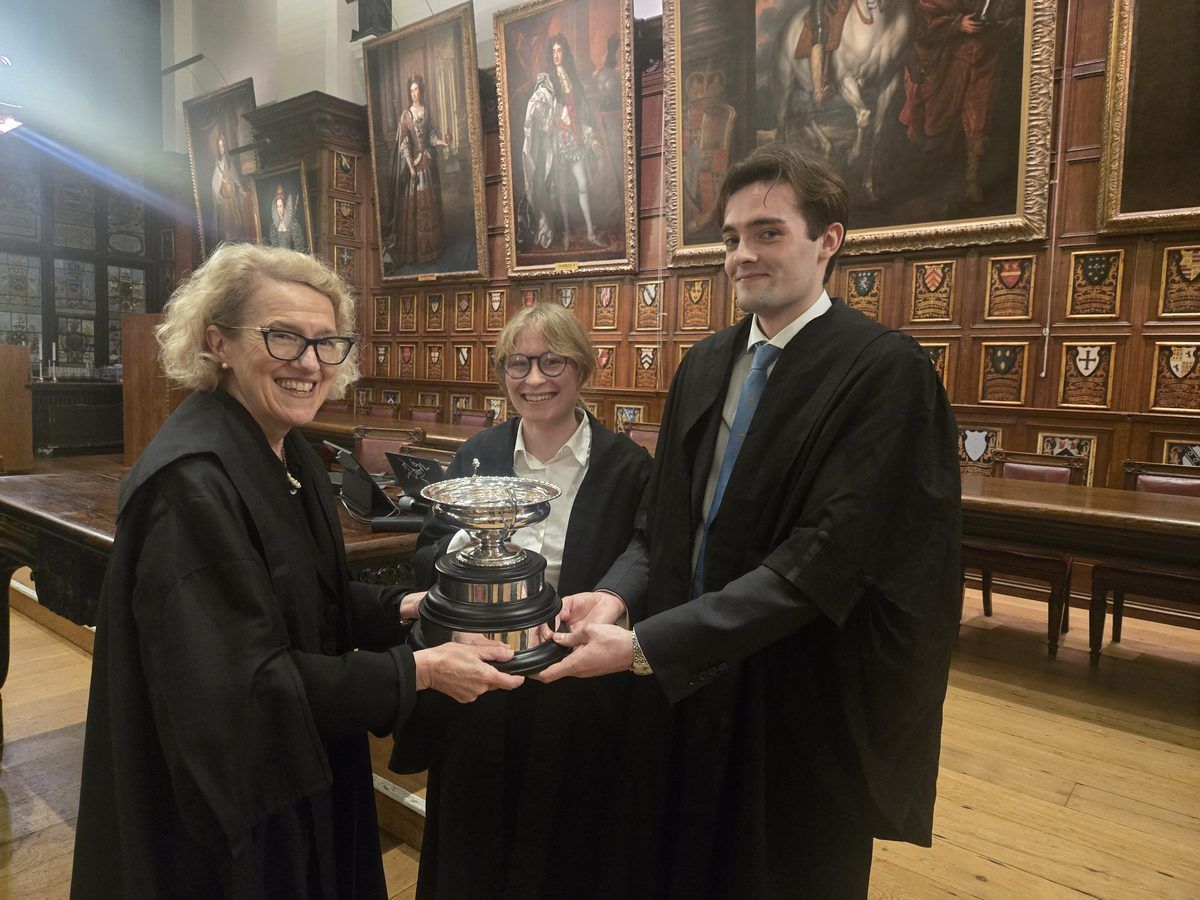
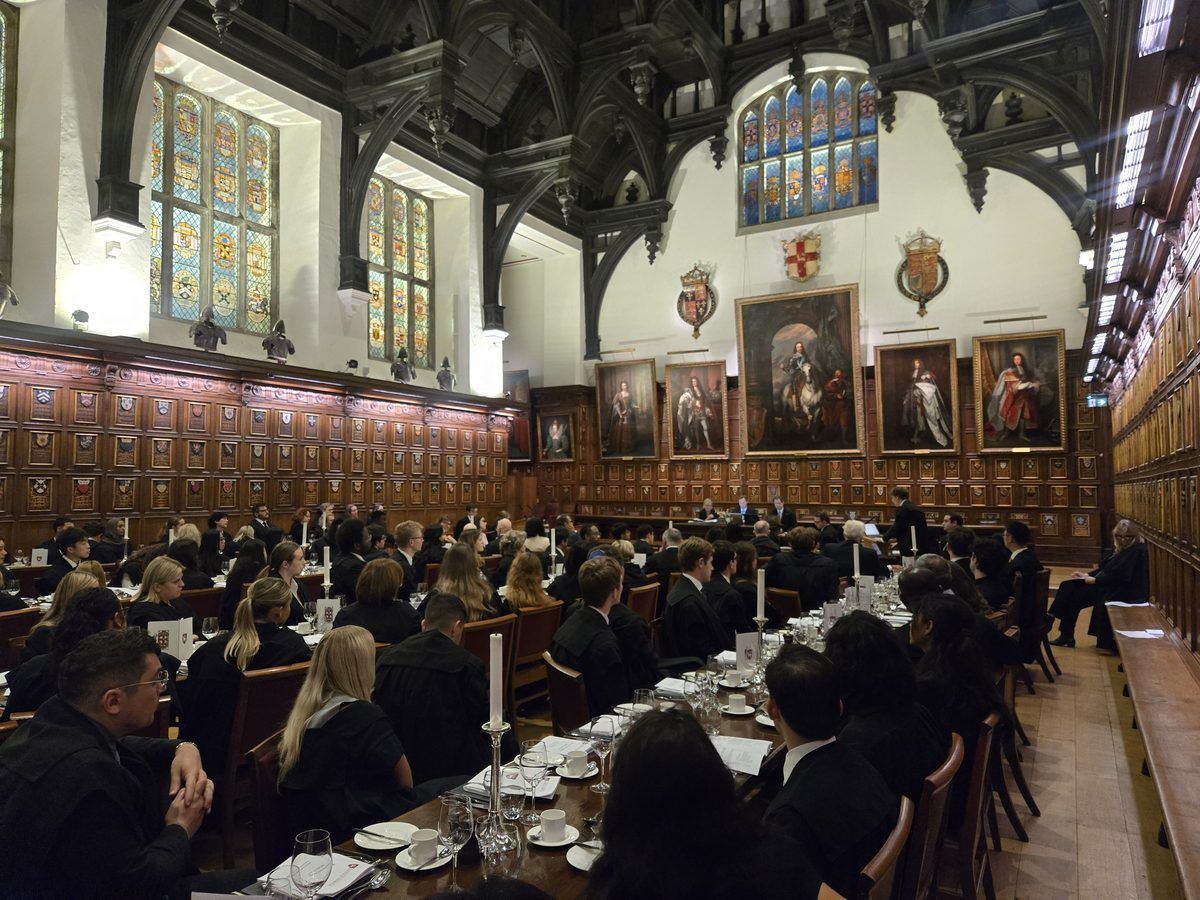
Over the course of the competition, we enjoyed moot problems concerning construction negligence, sanctions regimes, clinical negligence, duties of care and judicial review.
Each of these problems required us to get to grips with diverse facts and research authority spanning a range of practice areas.
The final moot problem involved facts similar to the case in R (on the application of Ammori) v Secretary of State for the Home Department [2025] EWHC 2013 (Admin). The problem was written by Professor David Feldman KC (Hon) FBA.
Final Round Moot Problem Facts
The facts were as follows:
We argued on behalf of the Appellant, the Director of Public Prosecutions.
The Respondent, Mr Haddock, was the Chair of a proscribed organisation, Combat War. The organisation was proscribed following arson attacks carried out on the Ministry of Defence and companies supplying arms to the UK.
Combat War was added to the list of proscribed organisations pursuant to section 3 of the Terrorism Act 2000 (TA) by way of amendment to Schedule 2 of the Act. In response, Combat War applied (pursuant to section 4 of the Act) to be removed from the list of proscribed organisations on the following grounds:
(i) That the organisation’s ethos disapproved of terrorism;
(ii) that the proscription order interfered with the exercise of its member’s and supporter’s Convention Rights (in particular, ECHR Article 9 (freedom of thought, conscience and religion), Article 10 (freedom of expression) and Article 11 (freedom of peaceful assembly and association);
(iii) that the proscription was disproportionate; and
(iv) that the proscription order was irrational.
This application was rejected by the Home Secretary, following which Combat War failed to exercise its section 5 TA right to appeal this rejection to the Proscribed Organisations Appeal Commission.
The following year, the Respondent protested outside a Ministry of Defence building holding a sign with the words ‘Combat War: Make Love not War’. In response, the Respondent was arrested and charged with the offence of being a member of a proscribed organisation contrary to section 11(1) TA.
The Respondent chose to represent themselves as a litigant in person at Westminster Magistrates’ Court, arguing that the proscription of Combat War was unlawful because:
(i) His Convention Rights had been violated; and
(ii) the proscription was Wednesbury unreasonable.
The Respondent also argued that in holding his sign he had been exercising his ECHR Article 10 right, and that there was therefore a requirement that the prosecution had to demonstrate that a successful conviction would not unlawfully violate his Convention Right under section 6(1) of the Human Rights Act 1998.
The prosecution argued that:
(i) Human rights challenges could only be brought before Proscribed Organisations Appeal Commission;
(ii) that challenging the proscription order by reference to Wednesbury unreasonableness in criminal proceedings amounted to an abuse of process; and
(iii) proportionality was ‘baked into’ the TA and there was therefore no possibility of the court making its own assessment.
The magistrates’ court rejected the prosecution’s argument at (i) but accepted the argument at (ii), declining to admit evidence on the issue and to assessing the compatibility of the legislation with Convention Rights. The Respondent was convicted and sentenced to a fine of £1 on each charge.
The Grounds of the Moot
On appeal, the Divisional Court upheld both rulings, but permitted an appeal to the Supreme Court on the grounds that the relevant case law was lacking in clarity and that two questions of general public importance arose:
(i) Whether challenging the validity of the proscription order in criminal proceedings did in fact amount to an abuse of process; and
(ii) whether it was open to the Respondent to argue that his Convention Rights had been violated by way of defence to a criminal charge.
Tips
Ultimately, our team won the final round. We felt that the moot itself, as with all mooting rounds before in the competition, was incredibly close-run. As such, we thought it might be useful to provide some general tips for mooting that we have found useful (non-exhaustive):
1. If you are making use of notes, make sure that you are not reading from them during your speech.
It’s important to plan your speech and practise it beforehand, but it is equally important that this doesn’t cross over into following a script.
2. Speak slowly.
It is easy to become flustered in the face of judicial intervention or simply from nerves. Slowing down your speaking will give you time to think and also make it look as though you are in command of your material.
3. Make tactical decisions as to the selection of authorities and lines of argument.
It can be tempting to throw all possible arguments at a problem in the hope that one will stick, however, given the limited amount of time for submissions it is far better to have a focused plan and hold to it.
4. Put forward a positive case.
Avoid dealing with your opponent’s argument in your skeleton argument. If necessary, this can be dealt with orally, but it is important not to detract from your case by becoming distracted with the other side.
5. When dealing with judicial intervention, answer questions as directly as possible.
Although it is tempting to put off an answer or follow a tangent, even if you don’t know the answer or don’t understand the question it is better to say so than risk avoiding the question altogether.
6. Try to anticipate judicial interventions.
The more cogent your response to an intervention the better, thinking of possible interventions allows you to prepare potential responses.
7. Try to anticipate your opponent’s arguments.
Although, as mentioned above, it is important not to become distracted with your opponent’s case, it pays to know how their case may develop and even what authorities they might draw from. You can then try to pre-empt any potential pitfalls in your argument.
8. Work together as a team, not as individuals.
Preparation with your partner is essential, practise together, run arguments past each other and know how your arguments and grounds interact.
9. Check drafting.
Mistakes in written submissions can undermine your case and give the impression that you haven’t prepared adequately. It particularly matters for those judges that put more emphasis on written submissions.
10. Remain flexible where possible in the face of intervention but also stand your ground where necessary.
It is important to know the essential perimeter of your case and to defend it. Moving from it in an attempt to placate a judge will only ultimately undermine your efforts.
We are grateful to the organisers, judges and authors of the competition’s problems.
William Sanders is a recent graduate of the Inns of Court College of Advocacy, supported by a Lord Diplock Scholarship awarded by Middle Temple. He completed the Graduate Diploma in Law at City, University of London and his undergraduate degree in English Language and Literature at the University of Oxford. He was awarded the Ede & Ravenscroft Award for Best Individual Performance in the Final of the Rosamund Smith Competition 2025.
Kate Tidmarsh is currently undertaking pupillage at Francis Taylor Building. She previously completed her Bar course at ICCA, which was supported by an Astbury Scholarship awarded by Middle Temple. She completed her Graduate Diploma in Law at City, University of London and her undergraduate degree in English Language and Literature at the University of Oxford. She also volunteered at the Campaign for the Protection of Rural England London as a policy and advocacy volunteer.