Some background
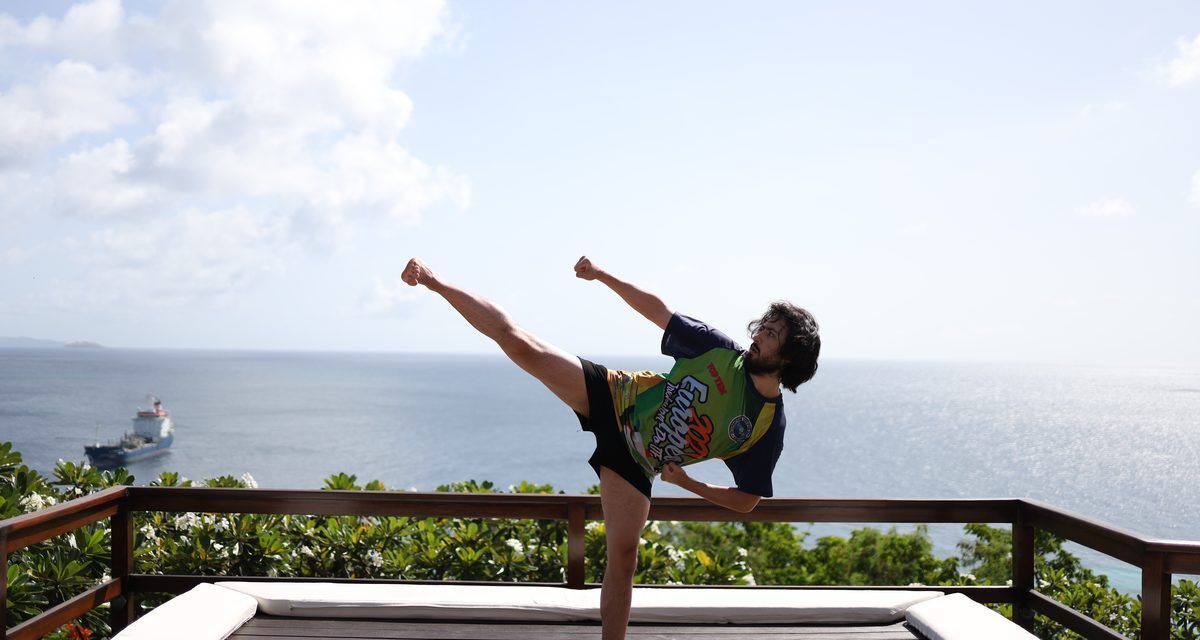
I started learning Taekwon-do when I was seven years old and have trained with the same instructor (the second most senior in England) for most of the past 15 years. Alongside this, I’ve had opportunities to train with a number of coaches, European and World champions across the UK, and further afield.
I should briefly note a little bit of context about Taekwon-do, a martial art developed in the early 1950s in South Korea for military use. However, over subsequent decades it has split into two different styles – one more traditional and one that has been modernised. I practise the more traditional style, which sadly means you won’t see me at an Olympic Games. The major practical differences are that the traditional style involves more competition across different events, with a higher degree of focus on patterns (a series of techniques against an imaginary opponent), power (breaking boards) and special techniques (hitting targets often over two metres in the air). Additionally, traditional sparring is semi-contact rather than seeking knockouts, but also allows punches to the head and face.
A few highlights
I’ve had the opportunity to represent England at a European and World Championship level, with my debut being back in 2021. At university level, I was ranked the best university level competitor in the 2024-2025 season and have won a total of six University World Championship medals since 2022.
Outside of university, I won bronze at the Open European Championship (2024). In 2025, I won a European bronze medal and was a double gold medallist at the Swiss Open. This year, I was the highest ranked British competitor in my division at the prestigious Warrior Open for a second consecutive year and won gold at the Impact Invitational. Competing at this level has given me the chance to meet, train with and compete against some of Taekwon-do’s most successful competitors who inspired my own competition journey.
Wider benefit
Importance of maintaining balance
Throughout my time studying law, I have found both training and competing in Taekwon-do to be very useful for maintaining balance in life. During my undergraduate studies, it was not uncommon for me to spend over 20 hours per week training with my club and the national team, alongside around 10 hours spent travelling. Balancing this with the rigours of a law degree often proved difficult. However, I consistently found that maintaining physical activity as part of my daily and weekly routine helped me stay sane during the long hours of revision and exams. The forced break in study most evenings helped my brain reset when tackling difficult problems. I also noticed that when I had something to look forward to at the end of the day, it acted as an effective incentive to get work done efficiently. I’ve (generally) managed to keep this approach going during both my masters and the Bar Course.
Developing self-discipline and perseverance
Taekwon-do instilled in me a high degree of perseverance and self-discipline. After achieving my first-degree black belt, I began facing competitors who were significantly more experienced than me. I often found myself losing in the first or second round of competitions, especially at an international level. This is one of the reasons that a large number of students quit after reaching black belt (often around half). However, during the Covid-19 lockdown I worked hard to improve my technique and fitness as a whole to try and push to a higher level. Through this hard work, instead of quitting I was able to start to challenge for the podium in high level competitions, and I was selected for the national team for the first time. Through this, I have recognised that often in life, success requires you to pick yourself up after a painful loss and to try again. I’ve found it useful to apply these same qualities to my pursuit of my legal studies and during the pupillage application process. I hope that it is a skill that will serve me well in my desired career at the Bar.
Giving back
One of the major ideals that Taekwon-do instils is a desire to give back. Throughout my time training and competing, I have been lucky to benefit from instructors and umpires giving up their time to help me improve and develop. In particular, umpires are usually unpaid even at a world championship level. These days, I regularly take the opportunity to coach and umpire at competitions myself to give back to the community. Over the past few years, I have chaired the British University Taekwondo League’s Student Umpire Committee, where I train students as umpires for national and international university competitions. In March of this year, I was also selected to be head referee of one of the rings at the University World Championships, where I had the opportunity to umpire a number of European and world medallists. These contributions led to me being awarded the prestigious Roy Marsden Prize for special contribution to British University Taekwondo (2025).
This desire to give back to a community is something I have also recognised is valued at Middle Temple. Last year, I was honoured to be given a scholarship by the Inn to support my Bar Course studies. The commitment of many members of Middle Temple in interviewing candidates for these scholarships, as well as judging moots and hosting Qualifying Sessions demonstrates this same commitment to giving back to help future generations at the Inn. Much like the Taekwon-do world, I have found Middle Temple a welcoming community and I hope to be able to contribute to this further as I develop.
What’s next
During the second half of 2026, my plan is to be Called to the Bar, alongside maintaining a busy competition schedule. At the time of writing, I have competitions planned in The Netherlands, Malaysia and Sweden, before travelling to Spain in late September to compete at the ITF Taekwon-do World Cup. I also look forward to spending more time around Middle Temple in the coming months.
Jonty Yin is a second dan black belt in ITF Taekwon-do. He won bronze at the Open European Championships (2024) and is a six-time University World Championship medallist. He was the first ever male Full Blue in Taekwondo at Cambridge. Jonty received the Hubert Monroe Bar Course Scholarship in 2025. He read Undergraduate Law at Downing College and a masters at UCL.